H.H. Holmes: America's First Serial Killer
← Return to Archive🎬 Watch H.H. Holmes: America's First Serial Killer
⚠️ Viewer discretion advised. Contains disturbing content based on real events.
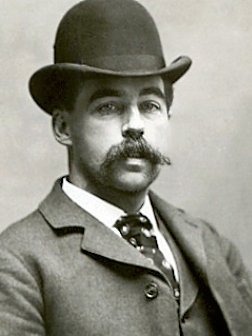
H.H. Holmes: The Devil in the White City He was a doctor, an architect, a con man, and a charlatan. But beneath the veneer of Gilded Age success, Dr. Henry Howard Holmes—born Herman Webster Mudgett—was building a monument to his own dark fascinations. In the shadow of the 1893 Chicago World's Fair, H.H. Holmes erected a hotel that would become infamous in American history: a "Murder Castle" designed for the express purpose of luring, torturing, and disposing of his victims. The Architect of the "Murder Castle" On the outside, the building at 63rd and Wallace was a marvel of industry—a three-story hotel, grandly named the World's Fair Hotel, built to house the flood of tourists visiting the Columbian Exposition. On the inside, it was a labyrinth of pure evil, a blueprint of its creator's mind. Holmes, who had financed the construction through a series of elaborate scams and insurance frauds, was the only one who understood its layout. He had hired and fired countless construction crews, ensuring no one but him knew the building's true design. The upper floors were a maze of over 100 windowless rooms, staircases that led to nowhere, and doors that could only be locked from the outside. A Labyrinth of Traps: Many rooms were connected by secret passages and false walls, allowing Holmes to move unseen. Gas Chambers: Holmes controlled gas lines that fed into several rooms, allowing him to asphyxiate his guests at the flick of a switch from his office. The Chutes: Trapdoors were installed in floors, and soundproofed chutes led directly to the building's most horrific feature: the basement. The Basement of Horrors The cellar of the Murder Castle was a private laboratory of dismemberment. Here, Holmes had all the tools of his gruesome trade: A Dissection Table: Used to process the bodies of his victims. A Stretching Rack: Believed to be an instrument of torture. A Brick Kiln & Crematorium: Large enough to incinerate human remains. Vats of Acid: Used to dissolve bodies, leaving no trace. Pits of Quicklime: To accelerate decomposition. Holmes, who had studied medicine at the University of Michigan, used his surgical skills to dissect many of his victims. He sold their articulated skeletons to medical schools and universities, profiting from their deaths even after they were gone. The Pitezel Scheme: The Beginning of the End While the true number of victims in the "Murder Castle" is unknown—sensationalist press at the time claimed over 200, while Holmes himself confessed to 27—it was not the Chicago murders that brought him down. It was an insurance scam. Holmes conspired with his long-time associate, Benjamin Pitezel, to fake Pitezel's death and collect on a $10,000 life insurance policy. The plan was simple: Pitezel would pose as a lab explosion victim, and Holmes would provide a convincing cadaver. Instead, Holmes betrayed his partner. He rendered Pitezel unconscious with chloroform and set him on fire, killing him. After collecting the insurance money, Holmes, a master manipulator, convinced Pitezel's widow that her husband was in hiding in London. The Hunt for the Pitezel Children What happened next cemented Holmes's reputation as a monster. He took custody of three of Pitezel's five children—Alice, Nellie, and Howard—under the guise of taking them to see their "hiding" father. This began a horrifying cross-country journey. Holmes traveled with the children, along with Pitezel's unsuspecting widow (whom he kept separate), moving from city to city. The grim pursuit was led by Detective Frank Geyer, a Philadelphia investigator hired by the insurance company. Geyer painstakingly tracked Holmes's movements, eventually uncovering the children's fates: The bodies of Alice and Nellie were found in a shallow grave in the cellar of a rented house in Toronto. Young Howard Pitezel was murdered separately. Holmes's confession later detailed how he dissected the boy's body, keeping small pieces of his bones. Capture, Confession, and Legacy H.H. Holmes was finally arrested in Boston in 1894—not for murder, but on an outstanding warrant for horse fraud. As Detective Geyer's case grew, the full story of the Pitezel murders unraveled. In his final days, Holmes wrote multiple, contradictory confessions, reveling in his infamy. He was tried and convicted for the murder of Benjamin Pitezel and was hanged in Philadelphia in 1896. The "Murder Castle" in Chicago mysteriously burned to the ground in 1895, its darkest secrets consumed by the flames. Today, H.H. Holmes is remembered as America's first serial killer, a man who turned the American dream of ambition and innovation into a blueprint for a nightmare.
← Return to Archive